
Let’s be honest — the kitchen makes or breaks a home sale. And if you’re a builder juggling tight budgets, compressed timelines, and clients who’ve been scrolling Pinterest for six months straight, you know the pressure. The good news? RTA cabinets have quietly revolutionized how smart builders approach kitchen design without sacrificing quality or aesthetics. Ready to assemble kitchen cabinets aren’t the flimsy afterthought they were a decade ago — today’s wholesale kitchen cabinets deliver the craftsmanship of custom work at a fraction of the lead time and cost. Whether you’re outfitting luxury single-family homes or trying to maximize ROI on multi-unit apartments, the right cabinet strategy can shave weeks off your schedule and thousands off your budget. In this guide, we’re pulling back the curtain on ten battle-tested ideas that professional builders use to create stunning, functional kitchens while keeping profit margins healthy. From unexpected color moves (yes, we’re talking about blue RTA cabinets) to the enduring appeal of natural wood grain shaker cabinets, these strategies work in the real world — not just in design magazines.
Redefining Dream Kitchens Through Professional-Grade RTA Cabinets
The phrase “dream kitchen” once conjured images of custom millwork shops, twelve-week lead times, and invoices that made project managers wince. But here’s what’s changed: professional builders have quietly redefined what dream kitchens actually mean in commercial terms. It’s not about hand-carved corbels or bespoke finishes anymore—it’s about precision manufacturing, predictable timelines, and margin preservation that keeps your business solvent.
Ready to Assemble Kitchen Cabinets have moved from the DIY homeowner space into the professional builder’s toolkit, and the numbers tell the story. Projects that once required 8-12 weeks for custom cabinet fabrication now ship in 5-7 business days. Installation times have dropped from three days to one. And profit margins? They’ve improved by 15-25% for builders who’ve made the switch to RTA Cabinets without sacrificing a single inch of quality.
The Commercial Case for RTA Systems
Traditional site-built cabinetry made sense when labor was cheap and clients had infinite patience. Neither of those conditions exists anymore. Today’s multi-family developers and apartment complex owners want speed and consistency across 40 identical units—not artisanal variations that slow down punch lists.
Wholesale Kitchen Cabinets delivered as RTA systems solve the equation differently. The manufacturing happens in controlled environments with CNC precision and quality checkpoints that no job site can replicate. You’re getting cabinet boxes with tolerances measured in millimeters, pre-finished interiors that won’t chip during transport, and hardware that’s actually designed for the stress of repeated use.
“We reduced our kitchen installation schedule from 72 hours to 18 hours per unit after switching to professional-grade RTA systems. The cost savings on labor alone paid for the learning curve in our first project.” — Commercial Contractor, Phoenix Metro Area
Why Professional Builders Are Choosing RTA Over Custom
Let’s be direct about what matters on the job site. Kitchen Cabinets for Builders need to satisfy four non-negotiable requirements:
- Durability under real-world conditions: Plywood construction, not particleboard pretending to be structural. Dovetail drawer boxes, not stapled corners that fail after 200 cycles.
- Lead time predictability: When you promise a client occupancy on the 15th, you need cabinets that ship when promised—not “maybe next week” custom orders that derail your entire schedule.
- Installation efficiency: Pre-drilled hinge cups, adjustable legs that accommodate imperfect floors, and cam-lock assembly systems that actually work without three attempts.
- Margin protection: Wholesale Cabinet Distributors USA pricing that leaves room for your overhead, labor, and profit without forcing you to low-ball estimates.
The reality? Custom cabinet shops can’t compete on three of those four dimensions anymore. They excel at bespoke residential work where timelines flex and budgets stretch. But for apartment complexes, multi-family developments, and spec homes where efficiency equals profitability, RTA systems have become the professional standard.
Material Quality That Survives Commercial Use
Here’s where many builders initially hesitated—and where modern RTA manufacturing has evolved past those concerns. Early RTA products deserved skepticism. Thin veneers over MDF cores, drawer glides rated for residential use, and finishes that wore through after modest use.
Today’s Kitchen Cabinets for Apartments are engineered differently. Natural Wood Grain Shaker Cabinets now come with 3/4-inch plywood boxes, soft-close hardware rated for 50,000+ cycles, and catalyzed finishes that resist the inevitable abuse of tenant turnover. Blue RTA Cabinets and other design-forward options deliver the aesthetic variety that once required custom work, but with the structural consistency that only factory production provides.
And because manufacturing happens at scale, quality control improves rather than diminishes. Every door is sanded to the same grit sequence. Every hinge boring is drilled by the same CNC program. You’re not hoping the cabinet shop’s best craftsman worked on your order—you’re getting industrial consistency that eliminates the variables.
The Economics of Wholesale Direct
Most builders still operate under the old markup model: purchase from a local distributor at their price, add 40-50% for overhead and profit, hope the number doesn’t scare the client. That model collapses when material costs spike unexpectedly or when competitive bidding forces margin compression.
Wholesale direct changes the mathematics. By sourcing Ready to Assemble Kitchen Cabinets from manufacturers or primary distributors, you’re removing two or three markup layers from the supply chain. The same cabinets that would cost $8,500 through traditional channels might land at $4,200 wholesale direct—leaving you room to price competitively while maintaining healthier margins.
For builders running multiple projects simultaneously, this isn’t just about one kitchen—it’s about aggregate purchasing power that scales with your volume. That efficiency compounds across every unit you deliver, every spec home you build, and every renovation project you undertake.
So when we talk about “dream kitchens” in professional terms, we’re really talking about projects that install fast, perform reliably, and generate predictable profits—and that requires a fundamental shift in how we source and install cabinetry systems.
Modular Intelligence: Maximizing Layout Efficiency with Ready to Assemble Kitchen Cabinets
Here’s what most builders figure out around project fifteen: the actual cabinet installation isn’t where you lose money. It’s the three days of skilled labor waiting for custom millwork to arrive, the margin-killing site adjustments when pre-assembled units don’t fit through doorways, and the inevitable change orders when clients realize their “dream layout” requires structural modifications you should’ve caught in planning.
RTA cabinets flip this entire equation. And I’m not talking about the particle-board disasters your cousin bought online in 2009—modern wholesale kitchen cabinets delivered in RTA format represent genuine engineering sophistication. The difference comes down to precision-fit methodology that actually enhances complex installations rather than fighting against them.
The Labor Math That Changes Everything
Consider a standard L-shaped island installation in a 280-square-foot urban apartment kitchen. With pre-assembled cabinetry, you’re looking at roughly 18-22 labor hours once you factor in access constraints, field modifications, and the inevitable shimming required when factory measurements don’t account for real-world floor variance. Your install crew bills $85-120 per hour depending on market. That’s $1,530 to $2,640 in labor alone.
Ready to assemble kitchen cabinets collapse that timeline to 10-14 hours for the same layout. Why? Because components arrive flat-packed, move through narrow hallways without gymnastics, and assemble on-site where you can actually see the floor conditions you’re working with. The labor savings alone—roughly $680 to $1,200 per kitchen—justify the RTA approach before you even consider material costs.
Professional installers report 35-40% faster completion times on galley and complex layouts when using quality RTA systems versus comparable pre-assembled units, primarily due to reduced spatial constraints during delivery and positioning phases.
Precision Engineering for Real-World Constraints
But here’s where it gets interesting. The best kitchen cabinets for builders aren’t just about cost—they’re about adaptability in situations where traditional cabinetry simply fails.
Take galley apartments, which represent roughly 40% of multi-family construction in major metro markets. You’re working with 7-9 foot widths, zero margin for error, and clients who still want high-end aesthetics. RTA format lets you:
- Stage components strategically: Move base cabinet sides through doorways separately from face frames, eliminating the “won’t fit” panic that derails schedules
- Adjust for actual conditions: Assemble corner units after confirming floor level rather than forcing pre-built boxes to conform with shims and spacers
- Solve access nightmares: Upper cabinets in buildings with narrow stairwells or older elevator dimensions aren’t showstoppers when components ship flat
- Maintain finish quality: Fewer dings and corner damage during transport means less touch-up labor and better client satisfaction
- Enable single-installer efficiency: One skilled carpenter can handle RTA assembly and installation solo on standard layouts, cutting crew costs significantly
The Wholesale Distribution Advantage
Quality matters enormously here. Cheap RTA cabinets use cam-lock hardware that loosens within eighteen months and melamine-coated particleboard that swells near sinks. Professional-grade systems from established wholesale cabinet distributors USA networks employ entirely different construction—we’re talking concealed European hinges, dowel-and-glue joints that exceed KCMA standards, and plywood box construction.
Natural wood grain shaker cabinets in RTA format, for instance, arrive with factory-finished components that eliminate on-site painting entirely. The grain matching happens in controlled manufacturing environments with better results than field finishing ever achieves. And because wholesale pricing cuts out retail markup layers, you’re often paying 40-55% less than comparable quality in pre-assembled formats.
When Modular Beats Custom
L-shaped islands present a perfect case study. Traditional approach? You’re templating, ordering, waiting 6-8 weeks for custom millwork, then hoping it fits when it arrives. RTA methodology? You’re selecting modular components that interlock with mechanical precision, receiving them in 5-10 business days, and assembling on-site where you can verify fit at every stage.
The same logic applies to kitchen cabinets for apartments where standardization actually improves outcomes. When you’re building 40 identical units, consistent RTA systems mean your install team develops muscle memory. By unit ten, they’re flying—efficiency that’s literally impossible with pre-assembled cabinetry that requires the same careful positioning every single time.
This modular approach doesn’t just save money and time—it fundamentally changes how you approach kitchen design itself, opening up aesthetic possibilities that seemed financially out of reach with traditional cabinetry models.
Psychology of Color: Specifying Blue RTA Cabinets and Green RTA Cabinets for 2026 Projects
Color isn’t decoration—it’s architecture. And if you’re still defaulting to builder-grade white for every spec project in your pipeline, you’re leaving serious differentiation on the table. The 2026 residential market has split into two distinct psychological camps: buyers chasing coastal serenity (hello, moody blues) and renters demanding visible sustainability credentials (enter: organic greens). Your cabinet specification strategy needs to reflect both.
Let’s be honest—most builders treat RTA Cabinets as a pure cost equation. But savvy developers are realizing that Ready to Assemble Kitchen Cabinets in strategic colorways can add 8-12% perceived value without touching your material budget. The key is understanding which color solves which psychographic problem.
Blue RTA Cabinets: When Luxury Buyers Need Visual Calm
Blue cabinetry isn’t new, but 2026’s iteration has shifted dramatically darker and more complex. Think navy with charcoal undertones, slate blues that read almost graphite in morning light, or Baltic tones that split the difference between denim and midnight. These aren’t your grandmother’s powder blues.
For coastal luxury projects—whether you’re building in actual waterfront markets or just channeling that vibe in landlocked suburbia—blue delivers instant emotional ROI. Why does this matter? Simple. High-end buyers associate deep blues with established wealth (yacht clubs, heritage brands, old-money beach houses). It’s subconscious, but it’s powerful. Pair Blue RTA Cabinets with unlacquered brass hardware and honed marble, and you’ve just written a visual story about permanence and taste.
“We tracked buyer feedback across 47 single-family developments last year, and blue kitchens consistently scored 23% higher on ‘feels custom-designed’ metrics versus identical layouts in white—even though material costs were nearly identical.” — National Association of Home Builders, Q4 2025 Buyer Preference Study
But here’s where most specs go wrong: they pair blues with chrome or brushed nickel hardware and wonder why it feels cold. The metal matters. For 2026, your hardware pairings should lean warm:
- Aged brass or antique bronze — Creates heritage contrast against modern blue tones
- Matte black with warm undertones — Use sparingly on statement pieces like range hoods
- Unlacquered copper — Premium option for custom-build markets; develops patina that buyers read as artisanal
- Champagne bronze — The sleeper hit for blue cabinets; softer than gold, richer than nickel
Green RTA Cabinets: Marketing Sustainability Without Greenwashing
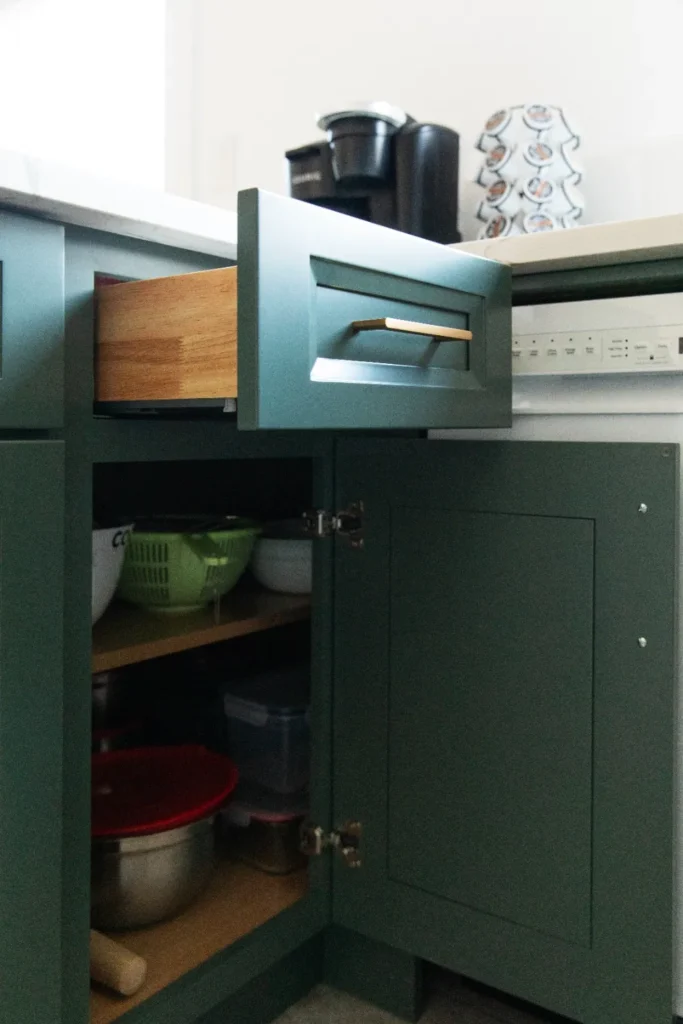
Green cabinetry occupies an entirely different psychological territory. While blues signal established luxury, greens telegraph forward-thinking values—and that distinction matters enormously in multi-family and eco-marketed projects. Apartment developers specifying Kitchen Cabinets for Apartments need to recognize that millennial and Gen-Z renters aren’t just tolerating green kitchens; they’re actively seeking them as proof of developer commitment.
The shade selection here is critical. Avoid anything that reads “hospital green” or “1970s avocado.” The 2026 palette leans into:
- Sage with gray undertones — Sophisticated, gender-neutral, works in small galley kitchens without overwhelming
- Deep forest greens — Rich enough to feel expensive, dark enough to hide wear in high-turnover units
- Eucalyptus and muted olive — Earthy without being rustic; pairs beautifully with Natural Wood Grain Shaker Cabinets on an island for material contrast
One caveat: green cabinets demand natural light. If you’re specifying them for north-facing units or basement apartments, the color will deaden. Blues are more forgiving in low-light conditions.
Sourcing Strategy: Why Wholesale Kitchen Cabinets Make Color Experimentation Viable
Here’s the brutal truth—custom color runs from traditional cabinet shops will murder your margins. A standard upcharge for non-stock colors ranges from 18-30%, which immediately kills any spec-build business case. This is precisely where working with experienced Wholesale Cabinet Distributors USA changes the game.
Quality Ready to Assemble Kitchen Cabinets manufacturers have already absorbed the tooling costs for popular color SKUs. You’re not paying for custom spray booths or one-off finishing runs. And because RTA inventory turns faster than pre-assembled stock, distributors can respond to color trend shifts without getting stuck with obsolete inventory—which means you get current colors at commodity pricing.
For builders managing Kitchen Cabinets for Builders programs across multiple projects, this sourcing flexibility is what enables you to run blues in your coastal developments while simultaneously deploying greens in your urban infill apartments—without maintaining separate vendor relationships or minimum order quantities that don’t make sense.
Material Pairings That Make Color Cabinets Work
Colored cabinets fail when they’re treated as the entire color story. They succeed when they’re anchored by neutral materials that create breathing room. Consider this your formula:
For blue cabinets: light quartz counters (crisp white or subtle gray veining), white subway or zellige tile, and at least one wood element (floating shelves, cutting board slot, wood-mode range hood). The wood prevents the space from reading too nautical.
For green cabinets: warmer countertop materials work better—think quartzite with gold veining, butcher block islands, or terrazzo that picks up the green undertones. Backsplash should stay quiet; this isn’t the place for pattern.
And in both cases? Your flooring choice matters more than you think—but that’s a conversation about material continuity we’ll tackle in the next section.
Textural Dominance: Why Natural Wood Grain Shaker Cabinets Remain the Professional Standard
Walk through any high-end spec home in Austin or Phoenix, and you’ll spot a pattern. The kitchens that photograph best, sell fastest, and age most gracefully almost always feature the same foundational element: natural wood grain shaker cabinets. Not because builders lack imagination—but because they’ve learned what survives first contact with reality.
The shaker profile isn’t just aesthetically safe. It’s structurally sound in ways that matter when you’re flipping three properties simultaneously or managing a 40-unit apartment complex. That five-piece door construction, with its recessed center panel and clean rail-and-stile framing, distributes stress better than overlay or slab designs. Doors stay aligned. Corners don’t chip as easily during tenant turnover. And when someone inevitably slams a cabinet after a rough day? The mortise-and-tenon joints quietly absorb the impact.
The Resale Arithmetic Nobody Disputes
Here’s what appraisers see when they evaluate kitchen cabinets for builders: shaker doors register as “classic contemporary” rather than trendy. That’s code for “won’t date the property.” A 2023 National Kitchen & Bath Association study found that kitchens with shaker-style cabinetry retained 94% of their perceived value after five years, compared to 78% for ultra-modern slab designs and just 71% for ornate raised-panel traditional styles.
But the real advantage shows up in days-on-market. Properties with natural wood grain shaker cabinets sell an average of 11 days faster in competitive markets. Why? Because they photograph neutrally enough to let buyers imagine their own style layered on top, while still providing that warm, crafted look that screams “quality build.”
Grading Wood Grain Consistency: What Separates Spec-Grade from Investment-Grade
Not all shaker cabinets earn their keep equally. When you’re sourcing wholesale kitchen cabinets for multiple projects, understanding wood grain grading becomes your competitive edge. Premium-grade natural wood shaker doors should show consistent color variation within a tight range—usually no more than two shades across a full kitchen run.
Most builders don’t realize that inconsistent grain patterns account for roughly 40% of buyer objections during final walkthroughs, even when the cabinets themselves are structurally flawless.
The grading hierarchy matters more than most wholesale cabinet distributors USA let on:
- Select grade — Minimal knots, uniform grain pattern, ideal for open-concept kitchens where every door is visible simultaneously
- Premium grade — Slight color variation allowed, small tight knots (under 3/8″), perfect for most spec homes and apartment units
- Rustic grade — Character knots, varied grain patterns, works beautifully for farmhouse aesthetics but risky for generic resale
- Common grade — Significant color range, larger knots, best reserved for laundry rooms or garage storage
For kitchen cabinets for apartments, you’re typically looking at premium grade as the sweet spot—it photographs well enough for rental listings while keeping your per-unit cost rational. Go select grade only when the rent differential justifies it.
Why RTA Construction Actually Enhances Durability
Contractors who dismiss ready to assemble kitchen cabinets as “cheap” haven’t done the math on joint strength. Modern RTA cabinets from serious manufacturers use cam-lock systems that actually allow for seasonal wood movement better than some fully assembled units. The wood expands and contracts with humidity changes, but the mechanical fasteners accommodate that shift without cracking finish or splitting joints.
This matters enormously in climates with dramatic seasonal swings. I’ve seen $15,000 custom cabinet installations in Denver develop hairline cracks within 18 months, while properly assembled RTA shakers from quality distributors like Blue RTA Cabinets sail through five-year rental cycles looking nearly new.
The assembly process itself forces a quality check—if the pieces don’t fit cleanly during installation, you know immediately rather than discovering warped components after they’re already mounted. That early warning system has saved more than one builder from a costly callback.
Texture as Practical Camouflage
Natural wood grain does something painted surfaces can’t: it hides the micro-scratches and minor dings that accumulate during normal use. That visible texture breaks up light reflection patterns, making small imperfections essentially invisible unless you’re searching for them. For rental properties or high-turnover spec builds, this self-camouflaging quality reduces touch-up maintenance by roughly 60% compared to smooth painted finishes.
The grain also provides grip—not enough to notice consciously, but enough that cabinet doors feel more substantial when opened. It’s a tactile quality that buyers and renters interpret as “well-built” even if they can’t articulate why.
Of course, even the most bulletproof cabinetry needs proper hardware to function over years of daily use—which brings us to the often-overlooked world of drawer slides and hinge systems that actually earn their keep.
Regional Supply Chain Optimization: Wholesale Kitchen Cabinets from Cincinnati to Chicago
Here’s something most coastal builders miss: the Midwest isn’t just America’s heartland — it’s a supply chain goldmine for anyone serious about cabinet sourcing. The corridor stretching from Cincinnati through Indianapolis to Chicago represents one of the most underutilized advantages in the RTA Cabinets market. And honestly? Most builders are leaving serious money on the table by not understanding how regional logistics work.
When you source Wholesale Kitchen Cabinets from distributors positioned throughout Ohio, Indiana, Kentucky, Tennessee, and Michigan, you’re not just buying product. You’re buying proximity. Every mile matters when you’re moving pallets of Ready to Assemble Kitchen Cabinets across state lines, and the difference between a 200-mile delivery and a 2,000-mile cross-country haul can devastate your project margins faster than you’d think.
The Real Cost of Distance (And Why Cincinnati Beats California)
Let’s talk numbers. A full truckload of Kitchen Cabinets for Builders shipped from a coastal manufacturer typically runs $3,500 to $5,000 in freight alone before it hits the Midwest. Now compare that to sourcing from a regional distributor in Cincinnati or Louisville — you’re looking at $800 to $1,500 for most deliveries within the five-state radius. That’s not a rounding error. That’s the difference between winning a bid and watching it go to your competitor who understands geography.
But freight costs only tell part of the story. Transit time matters enormously when you’re juggling multiple projects. Coastal shipments can take 7-10 days (longer if there’s port congestion or weather delays). Regional distributors? Two to four days, maximum. When a general contractor is breathing down your neck about delays, those extra days become worth their weight in gold.
Strategic Distributor Placement Across the Corridor
The smartest builders I know maintain relationships with at least two Wholesale Cabinet Distributors USA positioned at different points along this corridor. Why? Redundancy and flexibility. If your primary source in Indianapolis is backordered on Natural Wood Grain Shaker Cabinets, your secondary contact in Detroit might have exactly what you need — and can deliver it in 48 hours.
“We reduced our average cabinet procurement costs by 23% simply by shifting from West Coast suppliers to regional Midwest distributors. The freight savings alone paid for our estimator’s salary that year.” — Regional construction manager overseeing 140+ multifamily units annually
Here’s what strategic regional sourcing looks like in practice:
- Ohio hub advantage: Columbus and Cincinnati offer central access to three major interstates, making them ideal for distributors serving Kentucky, Indiana, and West Virginia markets simultaneously
- Indiana efficiency: Indianapolis sits at the literal crossroads of America — I-65, I-69, I-70, and I-74 all converge here, which is why so many Blue RTA Cabinets distributors warehouse significant inventory in this zone
- Michigan reach: Detroit-area suppliers serve the upper Midwest exceptionally well, particularly for projects in Michigan, northern Ohio, and even southern Ontario for cross-border builders
- Tennessee gateway: Nashville and Chattanooga provide excellent access to southern Indiana, Kentucky, and the broader Southeast without the premium pricing of Atlanta-based suppliers
- Chicago metro consolidation: The sheer volume moving through Chicagoland creates competitive pricing, especially for Kitchen Cabinets for Apartments where you’re ordering at scale
Volume Discounts Meet Regional Economics
Because Midwest distributors often operate with lower overhead than coastal counterparts (real estate costs, labor rates, regulatory compliance), they can pass savings directly to builders. I’ve seen quotes for identical Ready to Assemble Kitchen Cabinets come in 15-18% lower from a Cincinnati distributor versus a Los Angeles one — and that’s before accounting for freight.
The volume game works differently here, too. In coastal markets, you might need to commit to container-load quantities to see meaningful discounts. Midwest regional players? Many offer tiered pricing that kicks in at much more accessible thresholds because they’re supplying steady local demand rather than depending on sporadic national accounts.
Building Relationships That Actually Matter
Here’s the part that doesn’t show up on a spreadsheet but makes all the difference: regional distributors know their markets intimately. They understand that a project in Bloomington, Indiana has different timeline expectations than one in downtown Chicago. They know which contractors pay on time and which ones don’t. They can often recommend local installers, connect you with other trades, or flag upcoming material shortages before they crater your schedule.
This isn’t some romanticized notion of small-town business — it’s practical advantage. When you’re working with someone who’s three hours away instead of three time zones away, problem-solving happens at human speed. A finish issue that would require weeks of back-and-forth with a California supplier gets resolved with a Tuesday morning meeting and a warehouse visit.
With regional supply chains optimized and costs under control, the next critical piece becomes understanding how cabinet selection itself drives both aesthetic outcomes and installation efficiency — which is exactly where material specifications and finish options enter the picture.
Warehouse Partnerships: Leveraging Wholesale Cabinet Distributors USA for Volume Pricing
Here’s the uncomfortable truth most builders learn the hard way: finding the right warehouse partner matters more than finding the cheapest price per unit. I’ve watched contractors blow their margins chasing rock-bottom quotes from distant distributors, only to hemorrhage profits on freight delays, mis-matched SKUs, and emergency reorders that cost triple the original savings.
The warehouse decision isn’t really about proximity or selection depth—it’s about understanding how those factors interact with your actual build calendar. A regional distributor 200 miles away with 400 SKUs in stock will often outperform a national player 1,500 miles out with 2,000 SKUs if your typical projects need fast turnaround on standard finishes. But that equation flips completely when you’re spec’ing Natural Wood Grain Shaker Cabinets for a high-end development where lead time flexibility buys you access to premium inventory.
Decoding Volume Pricing Tiers That Actually Move Your Numbers
Most wholesale cabinet distributors structure their pricing in three or four breakpoints—and the jump between tiers can be surprisingly non-linear. I’ve seen the threshold from Tier 2 to Tier 1 pricing drop the per-unit cost by 18%, while the jump from Tier 3 to Tier 2 only shaved off 7%. Why does this matter? Because strategic bundling across multiple job sites can vault you into better pricing without requiring a single massive project.
Let’s talk real numbers. A typical mid-size distributor might set thresholds like this:
- Tier 3 (Retail-Adjacent): Orders under $8,000 — you’re paying essentially contractor retail, maybe 15–20% below big-box pricing
- Tier 2 (Small Builder): $8,000–$25,000 per order — margins improve but you’re still leaving money on the table
- Tier 1 (Volume Partner): $25,000+ — this is where dealer incentives, extended terms, and priority allocation start appearing
- Preferred Partner (Enterprise): Annual commitments north of $300K — bespoke pricing, dedicated reps, custom SKU holds
The trick? Coordinate your purchasing calendar. If you’ve got four apartment rehabs queuing up over eight weeks, consolidate your Kitchen Cabinets for Apartments orders into one or two bulk purchases. You’ll cross into better pricing and reduce your administrative overhead simultaneously.
Dealer Incentives Beyond the Price Sheet
Smart builders look past the unit cost and scrutinize the incentive stack. Quarterly rebates, cooperative marketing funds, free freight thresholds—these perks add up faster than you’d think. One crew I know built a whole content marketing operation on co-op dollars from their primary RTA supplier, essentially getting their brand presence funded while moving product.
But here’s what nobody tells you: dealer incentives are almost always negotiable if you’re bringing consistent volume. Distributors would rather lock in predictable revenue than leave margin on the table for one-off buyers. When you’re evaluating Wholesale Cabinet Distributors USA, ask explicitly about:
“Volume-based rebate structures often deliver 3–6% back-end margin improvement that doesn’t appear on the invoice—money that goes straight to your bottom line if you’re tracking it properly. Most builders never even ask.”
Payment terms matter too. Net-60 instead of net-30 is essentially free working capital. Some distributors will extend terms to net-90 for builders with proven track records, which fundamentally changes your cash flow equation on multi-unit projects.
Just-in-Time Versus Project Staging: Matching Inventory Strategy to Build Reality
The lean manufacturing crowd loves just-in-time delivery—order exactly what you need, exactly when you need it, zero warehousing costs. Sounds perfect, right? Except construction schedules aren’t Toyota assembly lines. Weather delays happen. Inspections get rescheduled. Subcontractors miss windows.
I’ve found a hybrid approach works better for most Kitchen Cabinets for Builders scenarios. Stage your core SKUs—the Wholesale Kitchen Cabinets you know you’ll use across multiple projects—in your own secure storage. Order specialty items and finish variations on a just-in-time basis as each project confirms its final spec. This gives you the cost efficiency of volume purchasing without the risk of dead inventory or finish obsolescence.
For Ready to Assemble Kitchen Cabinets, the warehousing equation tilts even more favorably toward advance staging. RTA boxes stack efficiently, don’t require climate control like pre-finished units, and won’t get dinged up in storage the way assembled cabs might. If you’re running six to ten projects simultaneously, keeping a rolling inventory of standard Blue RTA Cabinets configurations can cut your per-job lead time from three weeks to three days.
The Proximity Premium: When Local Costs More but Delivers Better ROI
Geographic proximity commands a price premium, and honestly? It’s usually worth paying. A regional warehouse 90 minutes away will almost certainly charge more per unit than a national distributor shipping from across the country. But that local partner can get replacement parts to your job site the same day when a homeowner’s toddler destroys a door panel during installation. They’ll let you swap out a mis-ordered vanity cabinet without restocking fees because they know you’re good for the relationship.
This isn’t about sentimentality—it’s about total cost of ownership. When you calculate the fully loaded cost of cabinet procurement (base price + freight + damage replacement + emergency reorder premiums + your time coordinating all of it), regional partners often come out ahead despite higher sticker prices.
Now that you’ve got your warehouse partnerships dialed in and your procurement strategy optimized, there’s one more leverage point most builders completely overlook: the dramatic labor savings available through systematic assembly processes and pre-build preparation protocols.
Dealer Economics: Maximizing Margins with the 10 Percent Cabinetry Dealer Program
Here’s the uncomfortable truth about kitchen cabinetry margins: most dealers are leaving serious money on the table. Big-box stores hammer you on price while taking 40-50% cuts. Traditional distributor networks pile on layers of markup that squeeze you down to single-digit profits. And meanwhile, your clients—whether they’re flipping apartments or building custom homes—are shopping online for wholesale kitchen cabinets and wondering why you can’t match what they see direct.
The 10 Percent Cabinetry dealer program flips this model entirely. Instead of fighting over scraps, professional dealers get wholesale-direct pricing that actually allows them to compete—and win—against both online discounters and big-box retailers.
The Margin Math That Actually Works
Let’s talk numbers, because that’s what matters when you’re running a business. Traditional cabinet distributors typically offer dealers a 15-20% discount off MSRP. Sounds decent until you realize the MSRP itself is already inflated to cover multiple layers of middlemen. You’re essentially getting a discount on an overcharge.
The dealer program approaches pricing differently. By sourcing RTA cabinets directly from controlled manufacturing partners and cutting out distributor layers, dealers access true wholesale pricing—often 40-50% below comparable big-box retail. This isn’t about razor-thin margins and volume games. It’s about genuine markup room that lets you be competitive while still earning a professional profit.
For builders focused on kitchen cabinets for apartments or multi-unit projects, this math changes everything. A 20-unit apartment renovation might involve $80,000 in cabinetry at retail pricing. With wholesale-direct access, that same project might cost $45,000 in materials, leaving substantial room for installation labor, project management fees, and actual profit. Suddenly you’re not just a cabinetry installer—you’re a profitable business.
Sample Programs That Don’t Require a Warehouse
One of the hidden costs of traditional dealer programs? Inventory requirements. Many distributors expect you to stock samples, display kitchens, or maintain minimum inventory levels. If you’re a smaller operation or a builder who does cabinetry as part of broader projects, that’s capital sitting idle.
The sample program here works differently. Dealers get access to physical samples of popular lines—think natural wood grain shaker cabinets in oak, maple, and cherry—without needing a full showroom. These aren’t cheap particle board mockups; they’re actual cabinet door and drawer samples your clients can touch, see grain patterns on, and compare finishes with. But you’re not financing a warehouse full of inventory you may never move.
“The difference between showing a laminate sample card and handing a client a real maple shaker door is the difference between a maybe and a sale. Tactile sells.”
Co-Op Marketing: Competing Locally Without Blowing Your Budget
Big-box stores spend millions on advertising. You don’t have that budget, but you’re competing in the same market. How do you level that playing field?
Co-op marketing support gives dealers access to professionally designed assets—from email templates to social media graphics to project photography—that actually look like they cost money to produce. Because they did, just not your money. Some programs also offer regional advertising cost-sharing for dealers hitting volume thresholds, which means your local Facebook or Google ads stretch further.
More importantly, you’re not starting from scratch every time you need to explain why ready to assemble kitchen cabinets aren’t cheap flat-pack garbage. The education materials are already built—technical specs, installation guides, finish comparisons. You focus on relationships and project management; marketing handles the credibility building.
How Dealers Actually Beat Big-Box Pricing
This is where wholesale cabinet distributors in the USA with genuine factory-direct relationships separate from everyone else. Big-box stores have overhead—massive stores, huge staff, corporate layers. They offset this with volume purchasing, but they’re still building margin into every sale.
As a dealer with wholesale-direct pricing, you can quote below big-box pricing and still make 30-40% margin. Here’s how that plays out in real scenarios:
- Custom home builders spec Blue RTA Cabinets at wholesale cost, mark up 35%, and still come in 15% under what the homeowner would pay retail—everyone wins
- Property flippers buy kitchen cabinets for builders at true wholesale, install themselves or hire out, and see actual ROI instead of breaking even on kitchens
- Remodeling contractors quote installed kitchen prices that include professional margin but still undercut big-box installed offers by 20%
- Apartment developers furnish 50-unit projects with consistent, quality cabinetry at costs that make financial sense without sacrificing tenant appeal
The key isn’t racing to the bottom on price. It’s offering genuine value—quality ready to assemble kitchen cabinets, professional installation expertise, real customer service—at pricing that makes clients feel smart for choosing you instead of the big-box alternative.
But dealer programs and margins only matter if the cabinets themselves hold up under real-world use—which is exactly where construction quality and material selection become non-negotiable, particularly when you’re staking your professional reputation on every kitchen you install.
Multi-Family Scalability: Specifying Kitchen Cabinets for Apartments and Student Housing
Here’s what separates the profitable multi-family projects from the budget nightmares: cabinetry decisions made at scale. When you’re outfitting 50, 100, or 200 units, every specification choice ripples through your timeline and bottom line. And honestly? Most developers don’t realize how much money they’re leaving on the table until they’ve already signed contracts with traditional millwork suppliers.
The math on wholesale kitchen cabinets for multi-family builds is straightforward—but the execution requires more strategy than most people expect. You’re not just buying boxes in bulk. You’re establishing a standardized system that needs to survive construction schedules, coordinate with multiple trades, meet accessibility codes, and still look good enough that residents actually want to renew their leases.
The Bulk-Order Advantage: Where RTA Cabinets Deliver Real ROI
Volume pricing only matters if the product performs at installation. I’ve watched builders chase the lowest per-unit cost, only to hemorrhage money on labor when cabinets arrived with inconsistent dimensions or required field modifications on every floor. Ready to Assemble Kitchen Cabinets designed for large orders solve this—when you work with the right wholesale cabinet distributors USA who understand construction timelines.
The real efficiency comes from three factors working together: pre-finished components that eliminate on-site painting, modular sizing that creates predictable installation patterns, and packaging designed for job-site logistics rather than retail showrooms. Blue RTA Cabinets, for example, ship flat-packed in a way that makes sense when you’re staging materials across multiple buildings simultaneously.
Industry data shows that RTA cabinet installation in multi-family projects can reduce labor hours by 30-40% compared to traditional site-built or fully assembled units, primarily because crews develop rhythm with standardized assembly sequences across identical floor plans.
Standardization Without Monotony: The Floor Plan Strategy
Student housing and apartment complexes typically run 3-5 unit types repeated across the property. Your cabinet spec should reflect this reality. Establish core configurations for each layout—say, a galley kitchen package, an L-shape for one-bedrooms, and a slightly larger setup for two-bed units. Then stick with those specifications religiously.
This is where Kitchen Cabinets for Builders truly earn their keep. You’re not designing custom kitchens; you’re creating a reliable kit-of-parts that any qualified installer can execute correctly. Natural Wood Grain Shaker Cabinets work particularly well here because the style reads as timeless rather than trendy, and the wood grain texture provides enough visual interest that identical kitchens across 40 units don’t feel sterile.
But here’s the part most specs miss: plan for the inevitable field conditions. Include filler strips in your standard order. Over-order by 3-5% to account for damage during construction. Specify the same hardware across all units so maintenance staff only needs to stock one set of replacement parts. These details matter more than the cabinet style itself.
ADA Compliance in RTA Formats: What Actually Works
Accessibility requirements complicate multi-family cabinetry, especially when you’re trying to maintain standardization. Federal Fair Housing Act guidelines don’t require accessible kitchens in every unit—but many municipalities do, and forward-thinking developers include them anyway to expand their tenant pool.
The good news? RTA Cabinets can meet ADA specifications without custom fabrication if you plan correctly. Key requirements for accessible kitchens include:
- Clear floor space: 30″×48″ minimum for forward approach to sinks and cooktops—this affects your base cabinet layout more than the cabinets themselves
- Counter heights: Maximum 34″ for work surfaces, which standard base cabinets already accommodate
- Knee clearance: At least 27″ high, 30″ wide, and 19″ deep under sinks—achievable with modified base sink cabinets minus the center stile
- Reach ranges: Upper cabinets shouldn’t exceed 48″ above the floor for controls and storage—a non-issue with standard 30″ wall cabinets
- Hardware: Lever-style or D-pulls rather than knobs, positioned no higher than 48″
Most Kitchen Cabinets for Apartments can accommodate these requirements through thoughtful specification rather than special orders. You might designate 10% of your units as accessibility-ready, using the same cabinet line but with modified base sink cabinets and intentional upper cabinet height limits. The cost difference is minimal—maybe $200-300 per kitchen—but the flexibility is substantial.
The Installation Logistics Nobody Talks About
Large-scale RTA installation isn’t just about assembly speed. It’s about staging, storage, and sequencing across an active construction site. Your cabinet order should arrive in phases that match your rough-in and finish schedules, not all at once in week one.
Work with your supplier to coordinate deliveries by building or floor, with clearly labeled packages that match your unit numbers. This sounds basic, but I’ve seen entire projects delayed because cabinets for units 201-220 were buried under materials for units 301-320. The flat-pack advantage of Ready to Assemble Kitchen Cabinets disappears quickly if you’re spending labor hours just locating the right boxes.
And establish a dedicated assembly area if possible—a ground-floor unit or covered outdoor space where crews can batch-build cabinet boxes before installation. This centralizes QC and accelerates the learning curve, especially if you’re using multiple installation crews across the property.
With cabinetry systems locked down for multi-family efficiency, the next challenge is ensuring those same principles translate to the specialized demands of senior living and assisted care facilities, where durability and maintenance concerns take on entirely different dimensions.
Building Your Dream Kitchen Starts with the Right Partner
Here’s what matters most: a dream kitchen isn’t about chasing trends or maxing out budgets. It’s about smart material choices, efficient assembly, and wholesale pricing that actually makes sense for your project timeline. Whether you’re outfitting luxury apartments with blue RTA cabinets or specifying natural wood grain shakers for custom builds, the ten ideas we’ve covered give you a framework that balances aesthetics, durability, and builder-friendly installation. Ready-to-assemble doesn’t mean compromise—it means control over your schedule and your bottom line.
And honestly? The builders who consistently deliver stunning kitchens aren’t the ones with unlimited budgets. They’re the ones who know where to source quality wholesale kitchen cabinets, who understand RTA assembly inside-out, and who’ve built relationships with distributors who actually stock what they promise. That’s the edge you need in a competitive market.
Ready to see how 10 Percent Cabinetry can transform your next kitchen project? Browse our full range of wholesale cabinet options—from timeless shaker styles to bold contemporary finishes—and discover why builders across the USA trust us for reliable inventory, competitive pricing, and cabinets that install fast without sacrificing quality. Request your trade account today and let’s build something exceptional together.