In the competitive world of kitchen and bath renovations, your reputation as a dealer hinges on one specific variable: the product you deliver to the job site. You can have the best showroom design, the most talented sales team, and the most efficient installers, but if the cabinets arrive with warped doors, mismatched finishes, or hardware that fails after six months, it is your brand that takes the hit.
The rise of Ready-To-Assemble (RTA) cabinetry has revolutionized the industry, offering speed and affordability that custom shops simply cannot match. However, this accessibility has flooded the market with varying degrees of quality. For a dealer, the challenge isn’t finding a supplier; it is filtering out the noise to find a partner that delivers consistency. This guide goes beyond the glossy brochures to look at the engineering, logistics, and financial realities of selecting a premier manufacturing partner.

Analyzing Cabinet Construction and Engineering Standards
When you are identifying quality cabinets, the investigation must start with the box itself. The structural integrity of a cabinet determines not just how long it lasts, but how easy it is to install. As a dealer, you want to minimize “callbacks”—those unprofitable trips back to a client’s home to fix a sagging drawer or a racking box. Understanding the engineering behind the cabinet is your first line of defense.
Plywood vs. Particle Board Composition
While particle board (often marketed as furniture board) has its place in low-cost environments, high-quality RTA cabinetry generally relies on plywood construction for the cabinet box. However, saying “plywood” isn’t enough. You need to look at the grade and the ply-count. Top-tier manufacturers use furniture-grade plywood, often 1/2 inch to 5/8 inch thick for the box sides, tops, and bottoms. The critical factor here is the number of plies (layers). A higher ply count results in a more stable board that is resistant to swelling from humidity changes—a massive factor in kitchens where steam and water are constant.
Furthermore, examine the back panel. Many budget manufacturers cut costs by using a thin 1/8 inch masonite back or a picture-frame construction that requires hanging rails. A superior RTA cabinet will feature a full-height, solid plywood back. This adds immense rigidity to the cabinet, ensuring it remains square during installation and supports the weight of heavy stone countertops without buckling.
Joinery Methods
How the pieces connect is just as important as what they are made of. In the RTA world, you will encounter cam-locks, metal clips, and dovetails. For the cabinet box assembly, metal clip systems or comprehensive interlocking grooves (dado joints) that are glued and stapled provide superior longevity compared to plastic cam-locks, which can loosen over time.
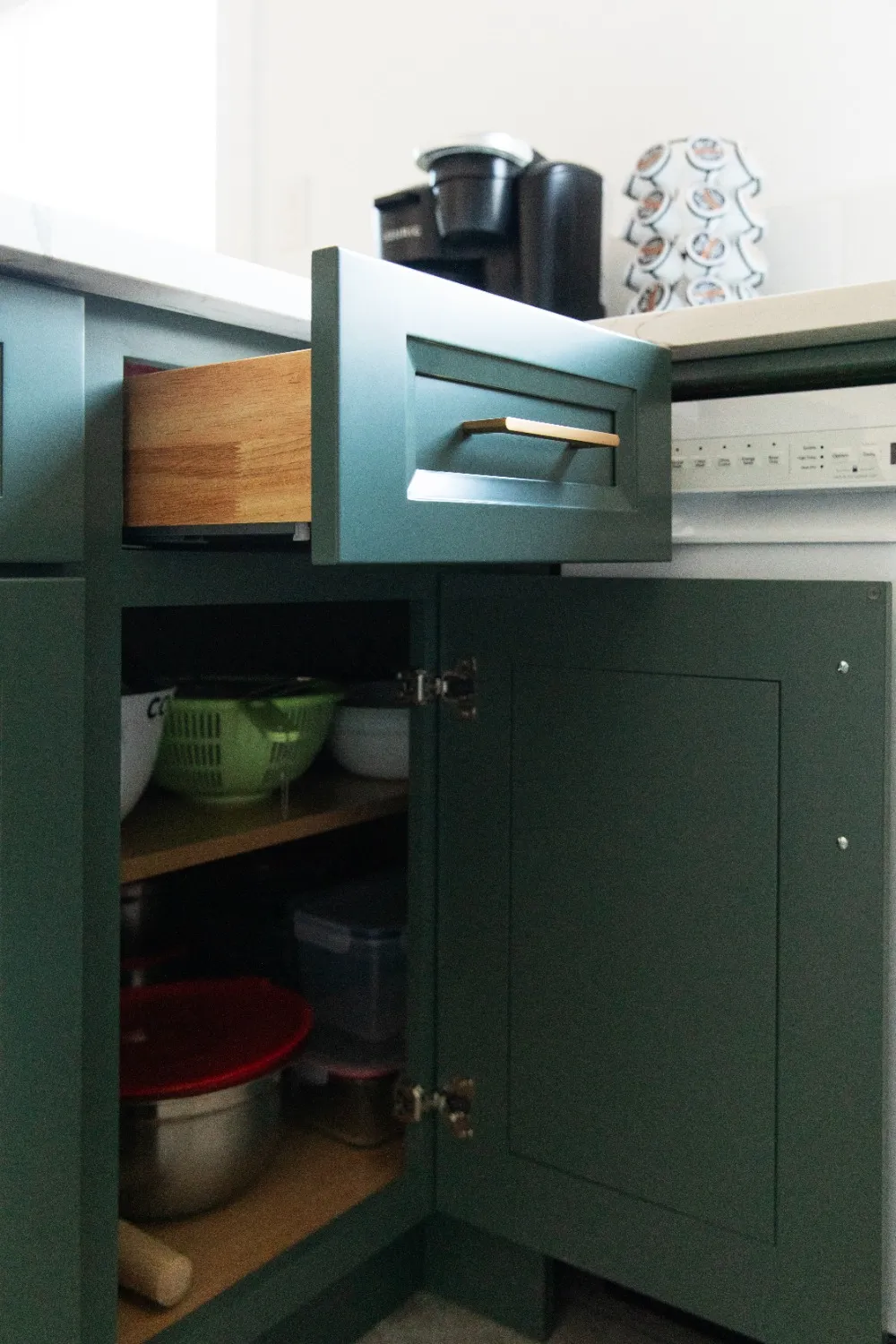
For drawers, the industry standard for quality is the dovetail joint. This interlocking wood joint resists the pulling force applied when a homeowner opens a heavy drawer. If a potential supplier offers stapled particle board drawer boxes, walk away. They will not survive the daily abuse of a busy American household.
Hardware Partnerships
The moving parts are the first things to fail. High-quality wholesale RTA distributors will partner with recognized hardware brands like Blum or DTC. You should insist on full-extension, under-mount drawer glides with soft-close technology. “Full extension” allows the homeowner to access the very back of the drawer, while “soft-close” is now a non-negotiable expectation for mid-to-high-end consumers. Similarly, door hinges should be 6-way adjustable. This adjustability is vital for your installers, allowing them to align doors perfectly even if the walls of the home aren’t perfectly plumb.
Durability, Consistency, and Aesthetics
Construction keeps the cabinet on the wall; the finish sells it. When evaluating a sample door, you aren’t just looking at the color; you are looking at the technology used to apply it. The finish is the cabinet’s armor against spaghetti sauce splatters, grease, UV rays, and cleaning chemicals.
Multi-Step Application Processes
A factory finish should be far superior to anything sprayed on a job site. Look for suppliers that utilize a multi-step finishing process—often involving 7 to 12 steps. This typically includes sanding, sealing, priming, painting/staining, and applying a protective topcoat. The depth of the finish matters. In stained cabinets, the stain should penetrate the wood grain rather than just sitting on top. In painted cabinets, the coverage should be opaque and uniform without “orange peel” textures or drips.
UV Curing and Chemical Resistance
Modern high-volume manufacturing utilizes Ultraviolet (UV) curing. This process instantly hardens the paint or varnish, creating a surface that is significantly harder than air-dried paints. Ask your potential supplier about their curing process. A well-cured finish resists chipping and scratching.
Furthermore, verify consistency. If you order a kitchen today and need an extra filler piece three months from now, will the white paint match? Leading manufacturers use automated mixing and spectrophotometers to ensure the “Arctic White” produced in January is identical to the batch produced in June. This consistency is critical for maintaining professional relationships with your clients.
The Touch Test
Never commit to a line without physical samples. Run your hand over the edges of the door and the inside of the panel profile. It should feel smooth like glass. Roughness in the corners indicates poor sanding preparation. Check the end grain on wood doors; if it looks much darker or blotchy compared to the face, the manufacturer isn’t sealing the wood properly before staining.
Supply Chain Logistics and Packaging Integrity
You cannot install what you don’t have. In the post-2020 economy, cabinet dealer supply chain reliability is the single biggest stressor for businesses. A supplier might have the best product in the world, but if their lead times are erratic or their inventory reporting is inaccurate, they will cost you money.
Inventory Depth and Transparency
High-quality wholesalers maintain deep inventory levels domestically. They should provide real-time or near real-time inventory feeds. Nothing is worse than selling a kitchen based on a “In Stock” label, only to find out 24 hours later that the sink base is backordered for eight weeks. Look for distributors with large, U.S.-based warehousing footprints that act as a buffer against international shipping delays.
Packaging Standards
RTA cabinets are shipped flat-packed. This reduces freight costs but increases the risk of concealed damage. If a box is dropped by a freight carrier, the cabinet inside needs to survive. Evaluate the packaging of your sample order.
Look for these protective measures:
- Double-wall corrugated cardboard: The exterior box should be heavy-duty.
- Corner protectors: Hard plastic or dense foam corners to prevent crushing.
- Styrofoam lining: A buffer between the cardboard and the finish.
- Strapping: The box should be strapped tightly so internal components don’t shift and scratch each other.
Pricing Structure and Dealer Margins
To run a sustainable business, you must balance competitiveness with profitability. The economics of RTA cabinetry are favorable, but only if you align with a supplier that offers a true wholesale structure.
Landed Cost vs. FOB Pricing
When analyzing price lists, ensure you are calculating the “landed cost.” Some suppliers show a low cabinet price but hammer you with excessive shipping fees, pallet charges, and handling fees. A transparent partner will have a clear freight policy—often a flat rate or a percentage of the total order, with free shipping thresholds for larger stock orders. This allows you to accurately quote your customers without fear of hidden backend costs eating your margin.
RTA vs. Pre-Assembled Profitability
Offering RTA cabinets gives you, the dealer, flexibility. You can sell them flat-packed to DIY homeowners or contractors, or you can assemble them in-house and sell them as “ready-to-install” units. The latter option significantly increases your profit margin. By investing labor into assembly (which takes 10-15 minutes per cabinet for a pro), you can charge a premium that far exceeds the hourly wage of the assembler.
| Metric | Selling Flat-Pack (RTA) | Selling In-House Assembled |
| Labor Cost | Zero (Customer/Contractor assembles) | Moderate (Shop labor) |
| Shipping Damage Risk | Low (Dense packaging) | Medium (Requires careful local delivery) |
| Perceived Value | Economy / Budget | Premium / Custom Feel |
| Typical Dealer Margin | 20% – 35% | 40% – 60% |

Warranty, Support, and Risk Mitigation
A warranty is a legal promise of quality. However, the bold print often differs from the fine print. Conducting a thorough cabinet warranty comparison is essential before signing a dealer agreement. You need to know exactly who is on the hook when a problem arises—is it the manufacturer, or is it you?
Defining “Lifetime Warranty”
In the cabinet industry, “Limited Lifetime Warranty” is the standard marketing term. But what does “Lifetime” mean? Usually, it refers to the lifetime of the original purchaser while they own the home. It is rarely transferable. You must verify what is covered. Does it cover warping doors? Peeling paint? Failed hinges? A strong warranty covers the replacement of parts free of charge. Be wary of warranties that prorate the value of the cabinet over time, meaning they pay out less the older the cabinet gets.
The Claims Process
Test the customer support before you need it. How easy is it to file a claim? Do they require you to ship the defective cabinet back (which is expensive and slow), or do they accept photographic evidence? Top-tier suppliers understand that time is money. If a door arrives scratched, they should be able to ship a replacement within 24 to 48 hours based on a photo submission. If the claims process involves jumping through hoops, your project timeline will suffer, and your client will blame you, not the factory.
Setting Up for Success
Once you have identified a partner that meets the construction, finish, logistics, and warranty criteria, the final step is integration. Becoming a cabinet dealer is not just about filling out a tax form; it is about equipping your business to sell the product effectively.
Showroom Samples and Displays
You cannot sell what you cannot show. Most high-quality wholesalers offer sample door programs or subsidized display cabinets for showrooms. Invest in these. Having a mini-base cabinet on hand allows you to demonstrate the soft-close drawers and the plywood construction to skeptical clients. It moves the conversation from “price” to “value.”
Digital Assets and Training
Does the supplier provide high-resolution images for your website? do they offer spec books with precise dimensions for your designers? Modern kitchen design relies on software like 2020 Design or ProKitchen. Check if the manufacturer has a digital catalog available for these platforms. This allows your designers to drag and drop the exact cabinets into a 3D render, pricing the job accurately and instantly. This seamless integration reduces ordering errors and speeds up the sales cycle.
Identifying high-quality wholesale RTA cabinetry is an exercise in due diligence. It requires looking past the initial price tag to evaluate the structural engineering, the sophistication of the finish, the reliability of the supply chain, and the strength of the warranty. As a dealer, your goal is to build a business that generates referrals, not complaints.
By partnering with a supplier that prioritizes quality and transparency, you protect your margins and build a brand known for excellence. If you are ready to elevate your product offering with cabinetry that meets these rigorous standards, explore the opportunities at 10 Percent Cabinetry. We provide the construction quality, inventory reliability, and dealer support necessary to help your business thrive in today’s market.

10 Must-Have Ideas for a Dream Kitchen
Let’s be honest — the kitchen makes or breaks a home sale. And if you’re a builder juggling tight budgets, compressed timelines, and clients who’ve been scrolling Pinterest for six … Read more

Craftsman Shaker Cabinets: The Trending Kitchen Door Style
The Cabinet Door That’s Actually Worth the Hype Walk into any design showroom right now and you’ll notice something: the craftsman shaker cabinets are stealing the spotlight. Not because of aggressive marketing … Read more
How to Transform Your Upper Cabinets with a Grey Shaker RTA Glass-Door Upgrade – A Step-by-Step Tutorial
If you’ve been dreaming of a kitchen cabinet makeover but dreading the hefty price tag and weeks of disruption, there’s a smarter solution that’s transforming kitchens across America. Grey shaker … Read more