
RTA Cabinet Brands Comparison 2026
About two years ago, I had a customer, a contractor doing a full kitchen gut in a mid-range spec home outside of Columbus, call me in a controlled panic because three of his upper cabinet doors had arrived with a finish that was noticeably lighter than the rest of the order. Not dramatically lighter. Subtly lighter. The kind of lighter that you might not notice in a showroom under warm lighting, but that jumped out under the LED strips he’d already installed. I got on the phone with the supplier’s rep, who was pleasant and ultimately useless. Replacement doors took eleven days. The install was delayed. The contractor ate the labour cost, and I ate a significant portion of my margin on the reorder to keep the relationship alive. That situation taught me more about what actually matters in a supplier relationship than any trade show conversation I’ve ever had.
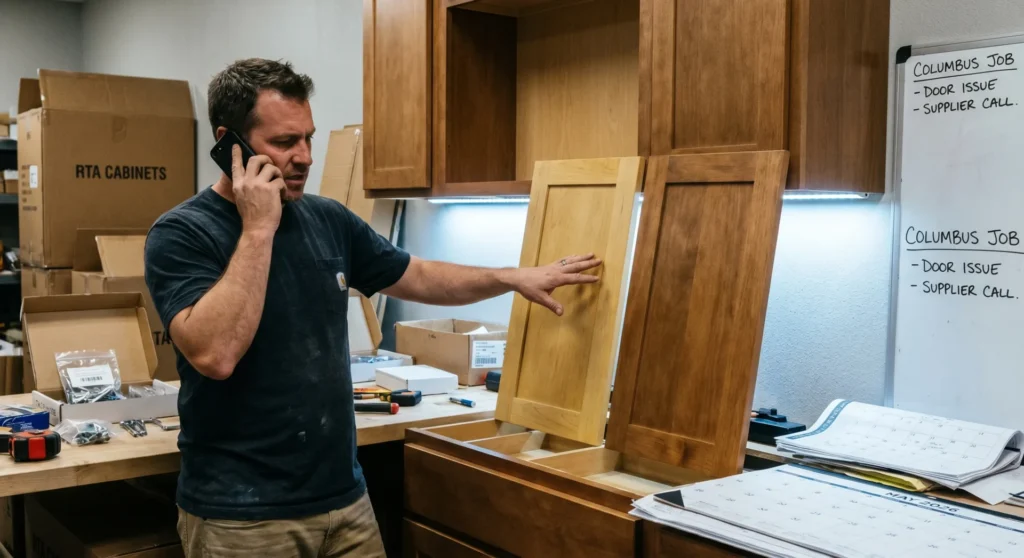
Since then, I’ve been methodical about how I evaluate RTA brands, not as a consumer looking for a deal, but as a dealer whose livelihood depends on whether the cabinets that show up are the cabinets that were ordered, in the right finish, undamaged, on time, and replaceable at a reasonable cost when something inevitably goes sideways. That’s a different checklist than what you find on most review sites. If you’re doing your own RTA cabinet brands comparison 2026, you’ve probably already noticed that most of the content out there was written for homeowners, not dealers.
What follows is my honest assessment of the major players in the U.S. RTA cabinet market right now, with a particular focus on 10 Percent Cabinetry, which has become a significant part of my sourcing mix over the past eighteen months. I’ll tell you what I like about them, what gives me pause, and how they stack up against the alternatives I’ve actually used or seriously evaluated. If you’re a dealer looking to make a real sourcing decision, read the whole thing. If you want a star-rating widget and an affiliate link, there are plenty of other articles for that.
RTA Cabinet Brands Compared: Is 10 Percent Cabinetry Actually Worth It for Dealers in 2026?
What Dealers Actually Need From an RTA Cabinet Brand (And Why Most Miss It)
Let me compress years of frustration into four criteria, because these are genuinely the only four things that determine whether a supplier relationship survives past the first six months.
Lead time reliability is first, and it’s not even close. I don’t care if your stated lead time is three weeks or six weeks — I care whether it’s accurate within a two-day window, consistently, across different order sizes. The brands that hurt dealers most are the ones with aspirational lead times. They advertise “ships in 5–7 business days” and then email you on day six to say there’s a backorder on the door style you just promised a client. I’ve been burned by this enough times that I now add a week to any stated lead time when I’m building a project schedule, which is a tax on my credibility with contractors that I resent paying.
Finish consistency across reorders is what I described in the opening. It’s also a more common problem than suppliers will ever admit publicly. The Columbus situation wasn’t an anomaly; it was the third time in eighteen months I’d dealt with a finish variance issue on reorders from that particular supplier. Once is a manufacturing fluke. Twice is a pattern. Three times is a supplier who doesn’t have adequate batch-to-batch color controls in place, and you need to know that before you build your business around them.
Damage and replacement policy matters enormously, and the variance between brands is shocking. Some suppliers have a clean, fast replacement process — you photograph the damage, submit a claim, get a replacement shipped within a few days, and the replacement ships free or at cost. Others require you to jump through so many hoops that you’d swear the policy was designed to discourage claims rather than resolve them. I have a rule now: before I commit meaningful volume to any supplier, I ask their rep to walk me through the exact process for a damage claim. How I get treated during that conversation tells me almost everything I need to know.
Margin structure is last on this list, but obviously not least in importance. The wrinkle here is that the margin on RTA cabinets isn’t just about the unit price. It’s about the total cost of the relationship — which includes the time your team spends managing exceptions, the cost of damaged freight, the occasional reorder you eat to keep a contractor happy, and the soft cost of delays that push your install schedules. A supplier with a slightly lower unit price but a chaotic logistics operation can easily net out worse than a supplier charging a premium with a clean fulfillment record. I’ve done this math the hard way.
The Brands in This Comparison
I want to be upfront about how I’m approaching this section. I’ve had direct sourcing experience with some of these brands and researched others closely enough to have informed opinions without having placed substantial orders. I’ll tell you which is which.
10 Percent Cabinetry is the primary subject of this article, and I’ll spend the most time on them in the next section. The short version: They’re positioned as a dealer-focused best RTA cabinet supplier for dealers with a pricing structure built around volume relationships rather than one-off consumer transactions. They’ve been building a reputation in the dealer community over the past couple of years, and based on my experience, most of that reputation is earned.
Lily Ann Cabinets is probably the most visible brand in the mid-tier RTA space right now. They have an enormous SKU range, aggressive marketing, and a reasonably smooth consumer buying experience. For dealers, though, the finish quality can be inconsistent at the lower price points, and their customer service is built for individual homeowners — not for a dealer managing multiple simultaneous projects. I know dealers who swear by them and dealers who’ve moved on. The ones who’ve moved on usually mention finishing issues and replacement turnaround as the reasons.
Wholesale Cabinets Warehouse offers some of the most competitive unit pricing in the market. That’s real and worth acknowledging. The trade-off, in my experience and based on extensive conversations with other dealers, is that the product quality at the bottom of their price range reflects those prices honestly. The box construction is fine for the cost, but the finish options are limited, and they know it. Where they make sense is for dealers doing high-volume, lower-margin work where the client isn’t scrutinizing finish quality at close range.
The RTA Store has been around long enough to have earned a degree of trust in the space. They carry a solid range of door styles, their assembly instructions are actually decent (this matters more than people admit — bad instructions create installation errors that come back to you), and their pricing is transparent. My hesitation with them is lead-time variability. Not always — but enough. They’re a reasonable option for dealers who aren’t working on tight timelines.
Cabinets To Go occupies an interesting middle position: they’re partly retail, partly dealer-facing, with physical showroom locations that some contractors find useful for client consultations. For dealers who operate purely online or phone-based, the showroom infrastructure doesn’t add much value. Their pricing isn’t as competitive as the pure-play online brands, and the product quality is solidly average — not bad, not remarkable. They’re probably most useful if you have clients who want to see something in person before committing.
CliqStudios is a brand I’ve watched more than sourced from directly, but I have a few colleagues who use them consistently and speak well of them. They punch above their price point in terms of finish quality, and their custom-size capability is a genuine differentiator for kitchens with non-standard dimensions. Where I’ve heard complaints — and this is secondhand, so apply appropriate skepticism — is on lead times during busy periods and on replacement part availability for older lines they’ve since updated.
10 Percent Cabinetry: What They Actually Do Well
I started paying attention to 10 Percent Cabinetry because a dealer I respect mentioned them casually in a conversation about margin compression. He wasn’t evangelizing; he just said, “I’ve been moving volume through them, and the math works out.” That’s the kind of recommendation that carries weight for me. Nobody paid him to say it. He said it because it was true at the time.
The name refers to their dealer pricing structure — the idea being that dealers can access pricing that isn’t available in the consumer market, with a margin baked in that makes the relationship economically viable for people running actual businesses rather than flipping a single kitchen remodel. I’ll be honest: when I first looked at their pricing, I was skeptical that the quality would hold up at that price point. It does. Not extravagantly — this isn’t custom European cabinetry — but the box construction is solid, the finishes are consistent within orders, and the hardware is better than average for the category.
Finish consistency across reorders is where I’ve been most pleasantly surprised. I’ve placed three substantial reorders to extend or modify projects that originally sourced from 10 Percent, and the finish match has been accurate every time. That might sound like a low bar, but if you read the opening of this article, you know it isn’t. Finish variance on reorders is one of the most relationship-destroying problems in this business, and a supplier who has it under control earns real loyalty from dealers who’ve been burned elsewhere.
Their damage and replacement process is clean. Not instantaneous — nothing is — but the workflow is clear, the communication is prompt, and I’ve never felt like I was being made to jump through bureaucratic hoops designed to wear me down into abandoning a legitimate claim. That matters. I’ve had suppliers where the replacement process was so painful that I started just eating the cost of minor damage rather than engaging with it, which is exactly what those suppliers were banking on.
The lead times are, and I want to be precise here, accurate more often than not. They’re not always the fastest in the category. But they tell me what they tell me, and it’s usually right. I’ll take an honest six days over a dishonest four days every single time.
Where 10 Percent Cabinetry Has Room to Improve
Their online ordering and project management interface is functional rather than elegant. I don’t need elegant. But a few of my younger contractors have mentioned that the workflow feels dated compared to some competitors. This is probably the least important critique I’m making — it doesn’t affect the quality of what shows up at the job site — but it’s worth noting for dealers whose teams are used to more polished digital tools.
I’d also like to see more transparency in their backorder communication. Most of the time, it doesn’t come up, but on the rare occasions when something is backordered, I’ve had to do more follow-up than I should to get a clear timeline. This is a minor complaint relative to suppliers, where it’s a major complaint, but it’s there.
Head-to-Head: How 10 Percent Stacks Up on the Criteria That Matter
| Brand | Lead Time Reliability | Finish Consistency | Damage/Replace Policy | Dealer Margin Structure | Style Range |
|---|---|---|---|---|---|
| 10 Percent Cabinetry | Strong — accurate estimates, rarely misses | Very good — consistent across reorders | Clear process, low friction | Built for dealers, genuine margin | Adequate — covers most residential work |
| Lily Ann Cabinets | Variable — better in slower periods | Mixed — lower price points show variance | Consumer-focused, slower for dealers | Volume discounts available but inconsistent | Very broad — one of the widest ranges |
| Wholesale Cabinets Warehouse | Generally reliable | Acceptable — limited finish options overall | Adequate, not exceptional | Lowest unit prices in category | Narrow — strong on basics, weak on variety |
| The RTA Store | Variable — struggles during high demand | Good when it arrives correctly | Reasonable but slow | Moderate — not optimized for dealers | Solid mid-range selection |
| Cabinets To Go | Moderate | Consistent at their price point | Retail-oriented process | Not dealer-optimized | Good — showroom presence helps clients |
| CliqStudios | Variable in peak seasons | Above average — finish quality is a strength | Mixed feedback | Moderate dealer accommodation | Wide — custom sizes available |
I want to be clear that this table represents my experience and my research as of early 2026. These things shift. A brand that had a rough year with logistics in 2024 may have fixed it. A brand that had a clean record may have grown faster than their operations could handle. Use this as a starting point, not a verdict.
The Margin Math: Why Dealer-Specific Pricing Actually Matters
Here’s something I want to spend a minute on because I think it gets glossed over in most comparisons of this type. When a supplier says they offer “dealer pricing,” that phrase can mean anything from a meaningful structural discount that changes your economics to a nominal five percent off a retail price that was inflated to accommodate the discount in the first place. The difference matters enormously to your P&L.
What I’ve found with 10 Percent Cabinetry is that the dealer pricing model is genuine in the sense that it’s built into the structure rather than bolted on as a marketing feature. The margin isn’t spectacular — I’m not going to pretend this is a category where anyone’s getting rich on individual cabinet sales — but it’s real and it’s consistent, which means I can build project budgets with confidence rather than renegotiating every time. That predictability has a dollar value that doesn’t show up on any invoice but is absolutely real.
Compare that to one of the large consumer-facing brands I was sourcing from before I shifted a significant portion of my volume — I won’t name them here because the specific criticism is about a pricing structure that may have changed — where the “dealer” discount was inconsistently applied and occasionally required me to escalate to a rep to get pricing that had been promised. The time I spent managing that relationship was time I wasn’t spending on anything productive. That’s a real cost.
I think dealers systematically underestimate the cost of administrative friction in their supplier relationships. A supplier who charges a slightly higher unit price but processes orders cleanly, communicates proactively, and handles replacements without drama can easily be the more profitable relationship even on paper once you account for your own time and your team’s time.
Who Should Actually Use Each Brand
Rather than declare a winner, which would be both arrogant and reductive, let me try to match each brand to the dealer profile where they make the most sense.
10 Percent Cabinetry makes the most sense for dealers doing consistent residential volume who need a reliable, dealer-oriented partner with good finish consistency and a clean operational relationship. If you’re placing multiple orders a month and you need a supplier who treats you like a business account rather than a consumer transaction, this is where I’d start. The style range limitation means you may need a secondary supplier for unusual specifications, but for the core of most residential kitchen work, they cover it well.
Lily Ann Cabinets makes sense if style variety is your primary constraint, if you’re regularly working with clients who have strong aesthetic preferences and you need a wide selection to close sales. Be prepared to manage the finished consistency issue at lower price points and build a slightly longer buffer into your replacement timeline.
Wholesale Cabinets Warehouse makes sense for high-volume, margin-sensitive work where the client’s expectations are calibrated to price rather than quality. Spec home builders, certain property management accounts, and flippers fall into this category. Don’t use them for clients who are going to spend time at close range with the finishes.
The RTA Store makes sense for dealers who aren’t working on aggressive timelines and who value the breadth of their selection and the quality of their assembly documentation. They’re a reasonable choice for less experienced contractors who need clear instructions to get the install right.
Cabinets To Go makes sense if you have clients who want a physical touchpoint before committing — if the showroom is near enough to be useful and you’re working in a market where clients want to see and touch before they buy. The economics aren’t as clean as pure-play online brands, but the in-person sales support has real value for certain client types.
CliqStudios makes sense for dealers who regularly encounter non-standard kitchen dimensions and need custom sizing without the lead times of a full custom cabinet shop. Their finish quality is a genuine strength at their price point, and if my secondhand information about their lead time issues is outdated, they’re worth a closer look as a primary supplier.
A Few Things I’d Want to Know Before Committing to Any Supplier
If you’re in the evaluation phase with any of these brands or any RTA supplier, here’s the short list of questions I’d want answered before I place my first real order.
Ask them to walk you through their damage claim process step by step. Don’t let them describe it in general terms. Ask specifically: what documentation do I need to submit? What’s the typical response time? How is the replacement shipped? And who pays freight on the replacement? The way they answer this question tells you how much they’ve thought about the dealer relationship versus the consumer relationship.
Ask for references from other dealers who have been sourcing from them for at least twelve months. Not three months — twelve. The first few months of a supplier relationship are almost always fine. The real nature of the relationship reveals itself in how they handle the inevitable problems over time.
Ask specifically about finished batch control on reorders. Use those words. See if the person you’re talking to knows what you’re asking about. If they don’t, that’s information.
And place a small test order before you commit to volume. Order from a few different door styles and finish combinations. Submit a minor damage claim, even if the damage is trivial, just to experience the process. You’ll learn more from that exercise than from any amount of conversation with their sales team.
My Honest Conclusion
If I’m summarizing where I land on this: 10 Percent Cabinetry has earned its place as my primary RTA supplier for standard residential kitchen work, and that position is based on eighteen months of real volume, not a single good experience I’m over-indexing on. The finish consistency, the damage process, and the fact that the dealer pricing structure is genuine rather than cosmetic — those three things together make them worth the conversation for any dealer who’s currently frustrated with their sourcing situation.
They are not perfect. The style range is narrower than I’d like, and I maintain a secondary supplier relationship for the projects that fall outside it. Their digital interface won’t impress anyone who’s used to polished SaaS tools. And I want better proactive backorder communication. None of those things has made me move volume elsewhere, which I think says something.
The deeper point — and this is what I’d want a dealer who just found this article to take away — is that the criteria most people use to evaluate RTA suppliers are the wrong ones. Unit price is a bad primary filter. Marketing quality is a bad signal. The number of SKUs in the catalog is mostly noise. What actually matters is whether the cabinets arrive correctly and on time, whether the finish holds up and matches on reorders, whether the replacement process is designed for dealers or against them, and whether the margin structure reflects a genuine partnership or a consumer transaction with a discount code slapped on it.
Evaluate on those criteria, and you’ll make better decisions than ninety percent of dealers I’ve talked to about sourcing. And if you end up evaluating 10 Percent Cabinetry seriously as a result of reading this, I genuinely think you’ll find what I found — a supplier that’s doing the fundamentals right in a category where that’s rarer than it should be.
Frequently Asked Questions
Is 10 Percent Cabinetry only for dealers, or can homeowners use them too?
Their pricing model is structured for dealers and contractors, which is the primary reason the margin math works the way I described. Individual homeowners can explore their site, but the relationship and pricing structure is genuinely oriented toward businesses placing recurring volume. If you’re a homeowner doing a single kitchen, some of the other brands in this comparison — Lily Ann, CliqStudios, Cabinets To Go — are more consumer-oriented and may be a better fit for a one-off project.
How does finish consistency actually work across RTA brands—is it a manufacturing issue or a logistics issue?
Both, honestly, depending on the brand and the specific situation. Some finish variance comes from inconsistent manufacturing processes — batch-to-batch color variation in painted finishes, for example, is a real and common problem that comes down to how tightly the manufacturer controls their paint mixing and application. Some variance comes from storage and shipping conditions — finishes that are sensitive to humidity or temperature fluctuation can arrive looking slightly different from the same order placed in a different season. The best suppliers have quality control processes that catch variance before it ships. The worst ones catch it when you call to complain.
What’s the most common mistake dealers make when evaluating a new RTA supplier?
Overweighting the unit price in the initial evaluation. I see this constantly. A dealer finds a supplier with a lower price per cabinet, moves significant volume to them, and then spends the next six months eating replacement costs, managing delayed projects, and losing contractor relationships — all of which adds up to a total cost that far exceeds whatever they saved on unit price. Evaluate the total cost of the relationship, not just the line item on the invoice. That means factoring in your own time, your team’s time, the downstream cost of delays, and the cost of damaged or mismatched product.
How often do RTA suppliers update their product lines, and does that create problems for dealers?
More often than you’d think, and yes, it can absolutely create problems. The most common scenario is a dealer who has an ongoing relationship with a customer — maybe a property management company doing multiple kitchens per year — who placed their first order in a specific door style that the supplier subsequently discontinued or updated. The finish on the new version doesn’t match the old one. Now you have a problem. The best way to protect against this is to ask suppliers directly about their product lifecycle policies and how they handle transition periods when lines are updated. Some handle it well. Some don’t think about it at all until you’re calling them with a problem.
Is the RTA cabinet market headed toward more consolidation in 2026?
I could be wrong about this, but my read is yes—the mid-tier is getting squeezed from both ends. On one side, you have the price-focused brands competing on increasingly thin margins. On the other hand, you have the emergence of dealer-specific suppliers who are carving out a more defensible position by actually servicing the B2B relationship rather than trying to be everything to everyone. 10 Percent Cabinetry’s positioning makes sense in that context. Whether consolidation accelerates over the next twelve to twenty-four months, I genuinely don’t know — but the market dynamics are pointing in that direction.
Read more:
Elevate Your Kitchen with Modern Shaker Cabinets
Maximize Your Home’s Value with RTA Kitchen Cabinets
6 Reasons Why 10 Percent Cabinetry is Your Ideal Choice
While RTA cabinets are known for their affordability, quality is never compromised. At 10 Percent Cabinetry, we use only the finest materials, including hardwood and plywood, to ensure durability and longevity. With our commitment to excellence, you can trust that your ready-to-assemble (RTA) cabinets from 10 Percent Cabinetry will withstand the test of time.
At 10 Percent Cabinetry, we pride ourselves on providing premium ready-to-assemble (RTA) cabinets, which provide the perfect combination of high-quality craftsmanship and affordability. Our ready-to-assemble (RTA) cabinets come in a wide range of styles, finishes, and configurations, offering homeowners to personalize their space to their exact specifications. Whether you prefer classic elegance or modern flair, 10 Percent Cabinetry is the perfect solution for you.
The days of hard and complex installation procedures are long gone. Because ready-to-assemble (RTA) cabinets are made to be easily assembled, homeowners may confidently take on the installation procedure. With ready-to-assemble (RTA) cabinets from 10 Percent Cabinetry, our team of professionals is available to help with installation, guaranteeing a smooth process from beginning to end.